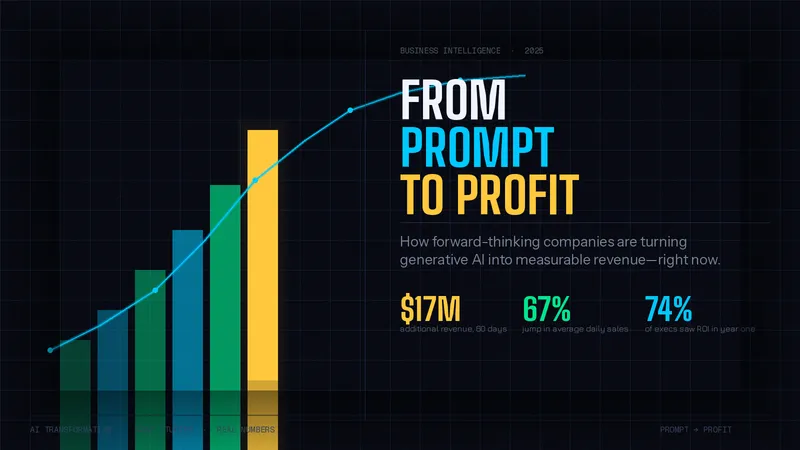
You’ve probably heard a lot of AI hype. Here’s something more useful: a company called AdVon Commerce once took on a client with nearly 94,000 products that needed updating. That kind of project normally takes close to a year. They finished in under a month. For one sporting goods client, sales jumped 67% within 60 days — an extra $17 million in revenue.
That’s what this is really about. Not robots, not sentient machines. Just businesses figuring out how to work smarter. The frustrating part? While 78% of organizations say they’re “using AI,” most are stuck running pilot programs that never go anywhere. There’s a big gap between doing AI and making money from it.
So here’s what’s actually working.
Customer Service: Why Saving One Minute Is Bigger Than It Sounds
Verizon put AI tools in front of 40,000+ customer service reps. Not to replace them — just to help. Instant information. Suggested responses. Account summaries pulled up before the rep even has to ask. The average call dropped from 18 minutes to 17.
One minute sounds like nothing. But multiply one minute across tens of millions of calls, and you’re suddenly looking at thousands of hours saved. And here’s the thing nobody talks about: the reps are less stressed. They’re not frantically clicking through five different systems while a frustrated customer waits. And because the routine stuff moves faster, humans actually get to be human more — solving real problems, showing empathy, doing the things AI can’t do.
Bolt, the European ridesharing company, built a chatbot that actually understands people. When someone says “I got charged twice this morning,” it doesn’t respond with “Would you like to learn about our pricing?” It gets it. Refund needed. Done.
Deutsche Telekom is on track to handle 38 million customer interactions with AI this year — not deflect them with useless responses, but actually resolve them.
The companies that mess this up try to automate everything at once. They build AI for every possible scenario, something inevitably breaks, and they declare AI a failure. The ones doing it right? They figure out the 20 questions that make up 80% of their support volume, make the AI really good at those, and expand from there. Boring, methodical — and it works.
Content Creation: Your Marketing Team, But With More Hours in the Day
Early AI-generated content was pretty rough. Generic, hollow, obviously machine-made. But two things happened: the tech got better, and smart marketers figured out how to actually collaborate with it instead of just letting it run loose.
Heinz used AI image generation to prototype marketing campaigns featuring different ketchup bottle versions. Normally that means photographers, props, studio time — slow and expensive. Instead, they tested concepts in hours. When something clicked, then they invested in full production.
Marketers are creating three to four times more content with the same team size. But here’s the key: they’re not publishing four times more. They’re testing four times more, finding what resonates, and going all-in on winners. The AI handles drafts; the humans decide what’s actually worth using.
One marketer described it well: “It’s like having an enthusiastic intern who writes reasonably well and never gets tired, but needs constant supervision and occasionally suggests completely ridiculous ideas with total confidence.”
That’s the workflow that works. Brief it clearly. Let it generate options. Have a real human pick the best bits, edit ruthlessly, add the strategic thinking and creative instinct that only comes from experience. Collaboration, not automation.
Coding: The Productivity Boost Developers Actually Believe In
Developers using AI assistants save over 10 hours a month on average. Some see 30-40% faster completion on specific tasks. Where does the time go?
Junior developers use it to stop Googling basic syntax and stitching together Stack Overflow answers. They describe what they need, get working code, verify it, and move on. The “how do I even start?” friction mostly disappears.
Senior developers use it differently — they already know the syntax. They use AI for the stuff that’s necessary but tedious: boilerplate, unit tests, documentation, refactoring. As one veteran put it, “I spend less time being a human compiler and more time actually thinking about architecture.”
A CTO framed it perfectly: “AI didn’t reduce our need for senior developers. If anything, we need more because we’re shipping faster and tackling bigger problems. What changed is that each developer gets more done, and junior developers come up to speed faster.”
That’s the right way to think about it. Not replacement — amplification.
Document Analysis: The Paperwork Problem Actually Has an Answer Now
Knowledge workers spend a shocking amount of time just looking for information. Hunting for one clause in a 50-page contract. Comparing two versions of a document. Summarizing a report so someone else can skim it.
It’s everywhere — legal, HR, finance, operations — and it’s exhausting.
UKG built an AI that lets HR administrators just ask questions. “What’s our remote work policy?” Answer: instant. No digging through folders, no tracking down whoever might remember. The information was always there — getting to it was the problem.
Dun & Bradstreet built search that handles queries like “Find renewable energy companies with ESG ratings above X, revenue over $50M, headquartered in Europe.” Traditional search can’t do that. Now you just ask.
The real benefit is hard to put in a spreadsheet: how many times have you made a decision based on incomplete information, not because better information didn’t exist, but because finding it would’ve taken too long?
Predictive Analytics: Shrinking the Guesswork
Business has always meant making decisions without full information. AI doesn’t change that entirely, but it shrinks the uncertainty considerably.
Geotab processes billions of data points daily from 4.6 million vehicles — speed, braking, fuel, diagnostics, weather, traffic. No human analyst could process a fraction of it. AI spots patterns across all of it simultaneously, helping fleet managers optimize routes, predict breakdowns before they happen, and cut fuel costs. Small improvements, but compounded across millions of vehicles, they add up fast.
PayPal’s story is genuinely striking. Between 2019 and 2022, their payment volume nearly doubled — from $712 billion to $1.36 trillion. Normally, fraud scales with volume. Instead, PayPal cut their fraud loss rate nearly in half during that same period. Their AI models adapt to new fraud patterns in two to three weeks. Traditional rule-based systems take months. By then, the fraudsters have moved on. Growing faster while losing less to fraud fundamentally changes what it means to operate at scale.
What Actually Separates the Winners
Time for honesty, because AI ROI claims range from genuinely impressive to wildly misleading.
The good news: 74% of executives report seeing ROI within the first year. The reality check: only 39% report it showing up in actual bottom-line improvement. Most companies still haven’t scaled AI beyond a few experiments.
The pattern among companies seeing real results is consistent. They pick two or three high-impact use cases instead of saying yes to every proposal. They redesign workflows around AI rather than just bolting it onto what they’re already doing. And critically — they frame AI as enabling people to do better work, not as a way to cut headcount. When you frame it as cost reduction, you get resistance and miss revenue opportunities. When you ask “what could we do that we couldn’t before?”, you get enthusiasm and often exceed your goals.
Change management isn’t optional here. 65% of employees are anxious about using AI correctly. If you ignore that, adoption tanks regardless of how good the technology is.
Also: budget more than you think. The tool costs are just the beginning. Data cleanup, model retraining, compliance reviews, exception handling — that $100K investment has a way of becoming $500K by the end of year one.
The Honest Bottom Line
AI isn’t magic. It won’t fix a broken business or solve problems you haven’t clearly defined. But when you implement it thoughtfully — specific use cases, good data, real support for the people using it, ongoing refinement — the results are substantial and measurable.
The companies winning aren’t chasing every new feature. They’re finding the places where AI creates clear value, testing carefully, measuring honestly, and scaling what works.
The question stopped being “should we use AI?” a while ago. The real question is: where would it actually help us, specifically? Answer that honestly, start small, and build from there.